The Fortalice of Ardgith
800 years in one garden
In 1652, an argument over a ditch ended in murder. That is one chapter. There is also a mistress installed in the castle, a tutor who killed his pupils, a poet refused at the gate and a coin dropped by a soldier who realised it was worthless.
The history starts a few hundred metres upriver, near where the bridges are now, and then moves to the Hill of Ardgith where the ruins still stand. Much of it is documented. Some of it is local tradition. We are still finding things out.
1132
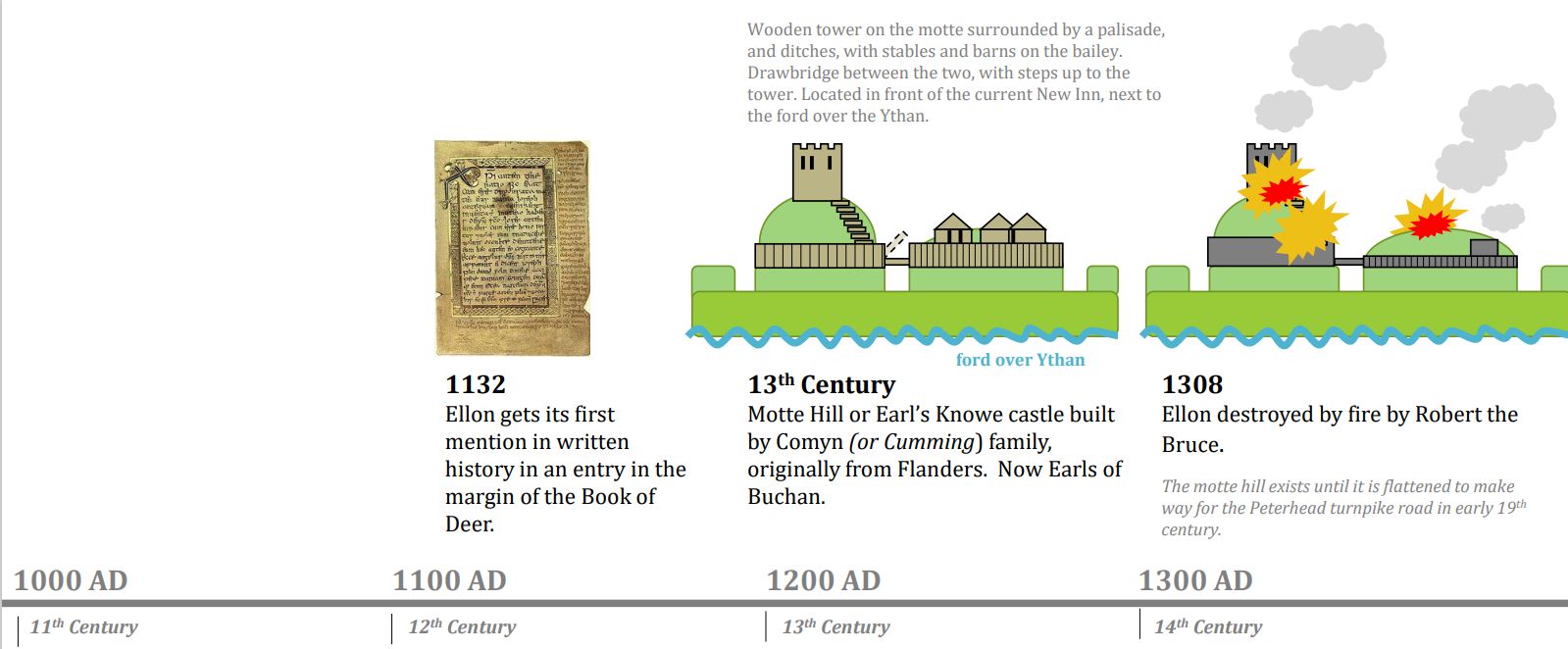
Ellon's first appearance in writing
Ellon gets its earliest mention in a note in the margin of the Book of Deer. At this point the motte and bailey castle stands a few hundred metres upriver, in front of where the New Inn is now.
From the garden's own illustrated history boards. 1382
The Wolf of Badenoch
Robert II gifts Ellon to his third son, Alexander Stewart, Earl of Buchan — remembered rather less politely as the Wolf of Badenoch.
1413
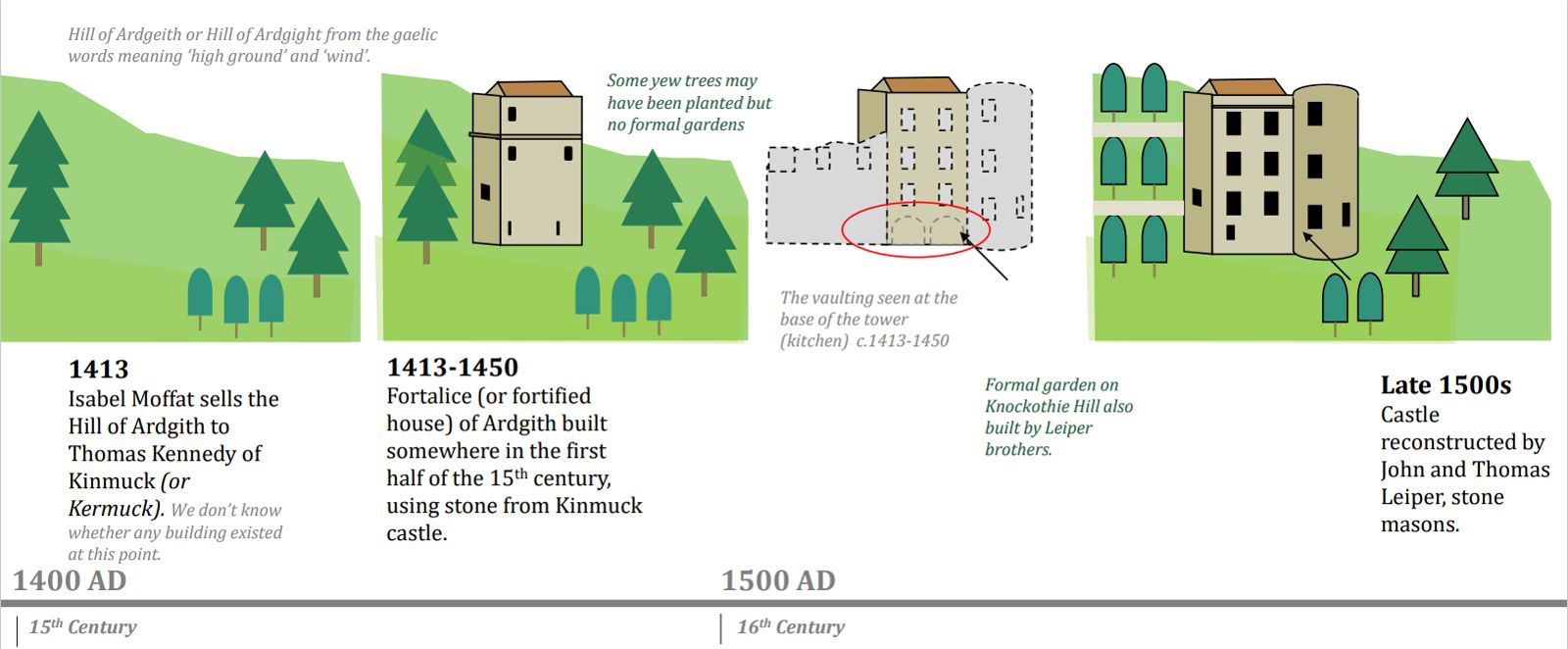
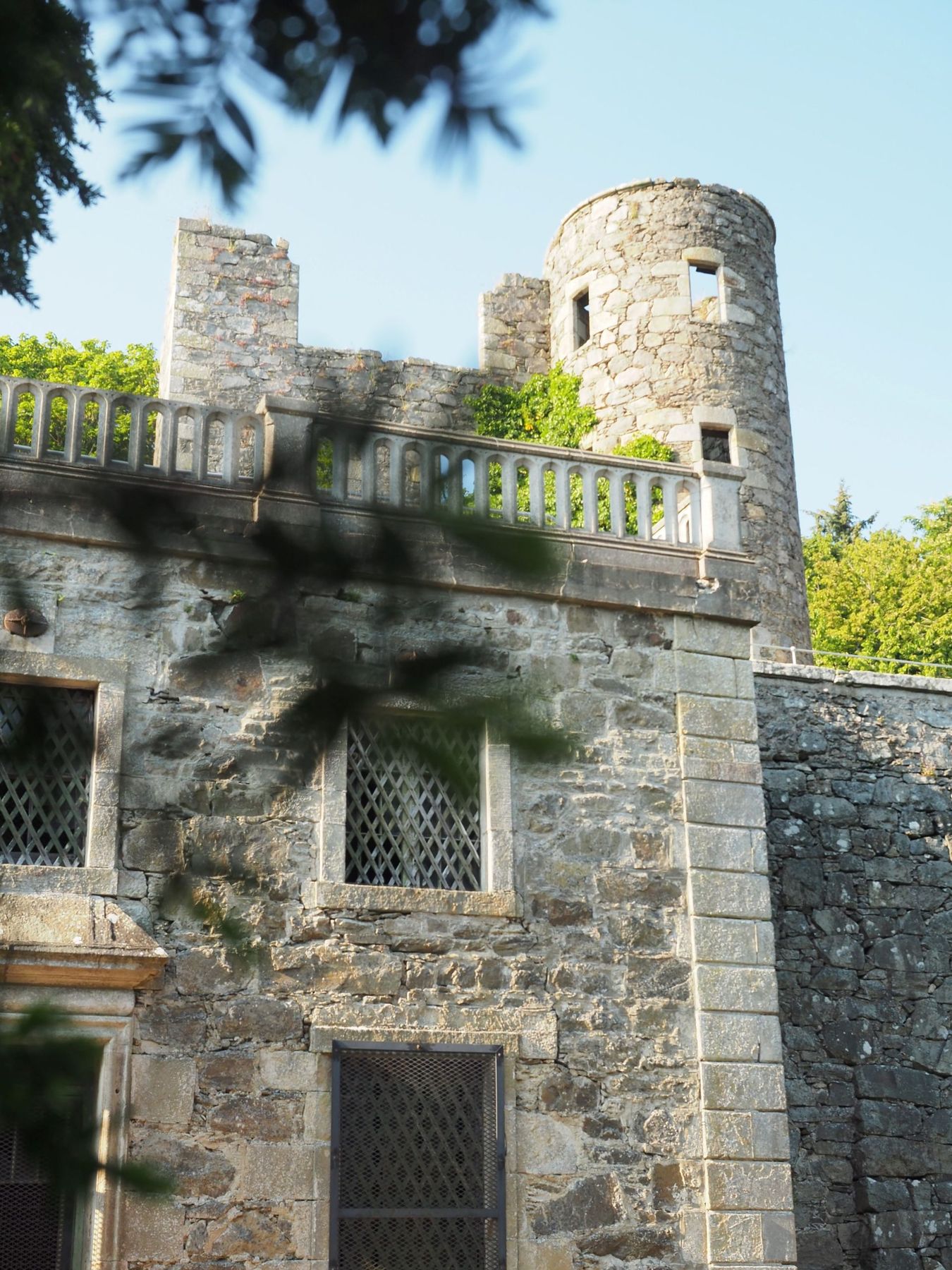
A castle on the Hill of Ardgith
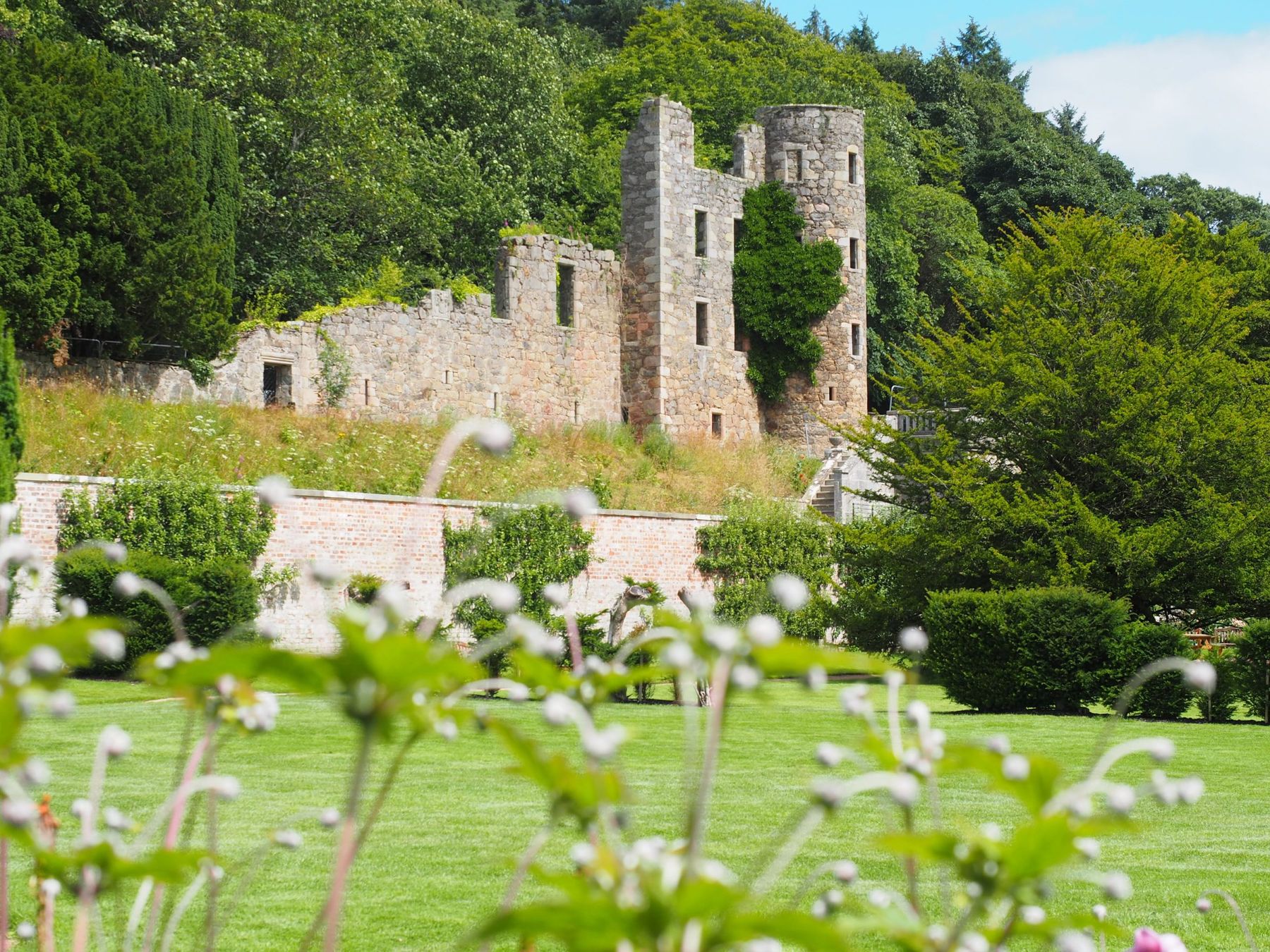
Kennedy of Kermuck buys land at the Hill of Ardgith from Isabel Moffat and builds the Fortalice of Ardgith. Some of the yews may already have been standing. We would very much like to know more about Isabel Moffat, and whether anything stood on the site before.
1505–1592
Four generations of Kennedys
William Kennedy becomes Constable of Aberdeen in 1505; John Kennedy and Marjory Cheyne inherit in 1543; their son John, married to Isobel Cheyne, follows in 1564; James Kennedy, married to Elizabeth Forbes, succeeds in 1592. The families of Kennedy and Forbes are by now thoroughly entangled — which makes what happens next worse.
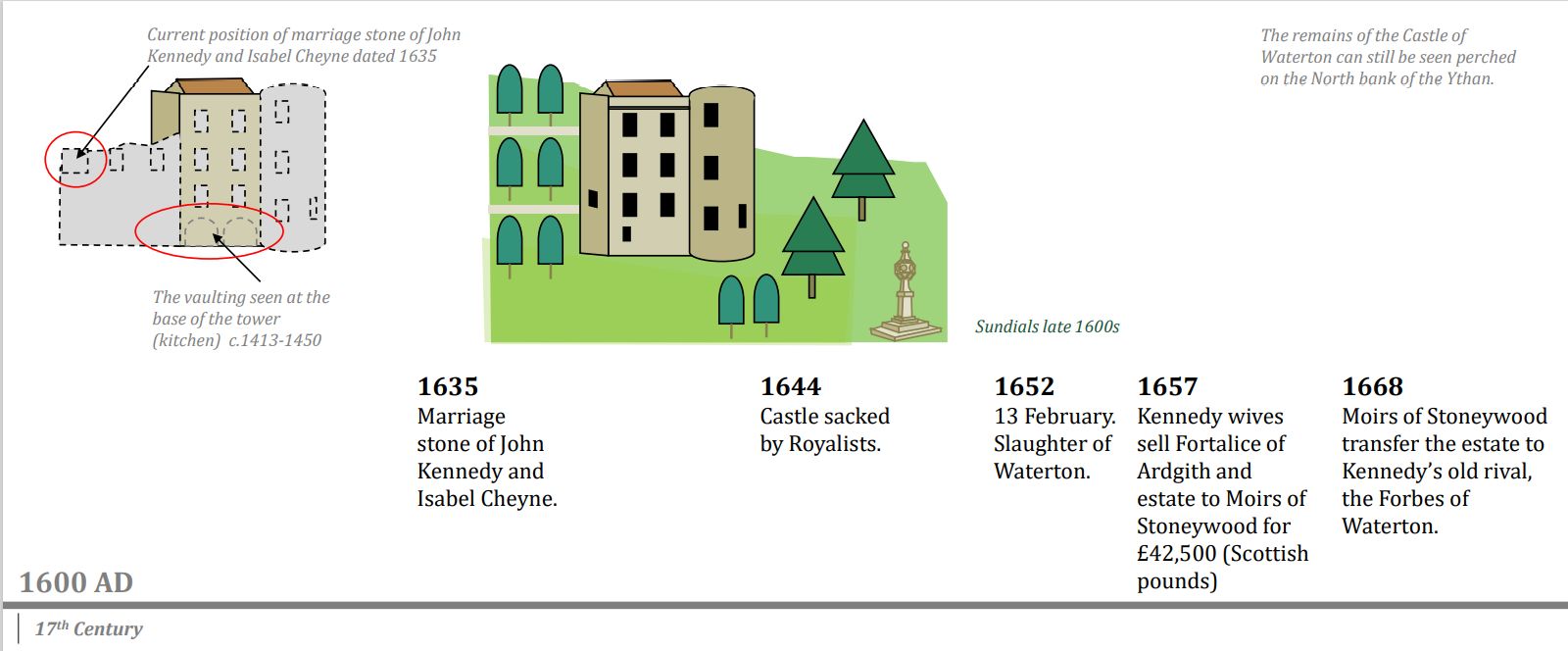
1607
John of the Great Sword
John Kennedy inherits. He is known afterwards as John of the Great Sword, which is not a name anyone acquires quietly.
1652
The Slaughter of Waterton
A dispute with the neighbouring Forbes family over a mill lade — a ditch — becomes a pitched battle. Thomas Forbes is killed and the Kennedy men flee Aberdeenshire to escape trial. In 1663 Thomas's son John is made hereditary Constable of Aberdeen by Act of Parliament, the Kennedy holder still being alive.
1652
The Slaughter of Waterton
A dispute over a ditch ends in bloodshed.
The Kennedys of Ardgith and the Forbes of Waterton were neighbours, and by the seventeenth century they were relations as well. None of it helped. The argument was over a mill lade — the channel that carried water to a mill — and it ran on until both households turned out armed.
Thomas Forbes was killed. The Kennedy men left Aberdeenshire rather than face prison and trial, and the constableship of Aberdeen, hereditary in the Kennedy family, passed by Act of Parliament in 1663 to Thomas's son John while the Kennedy holder was still living.
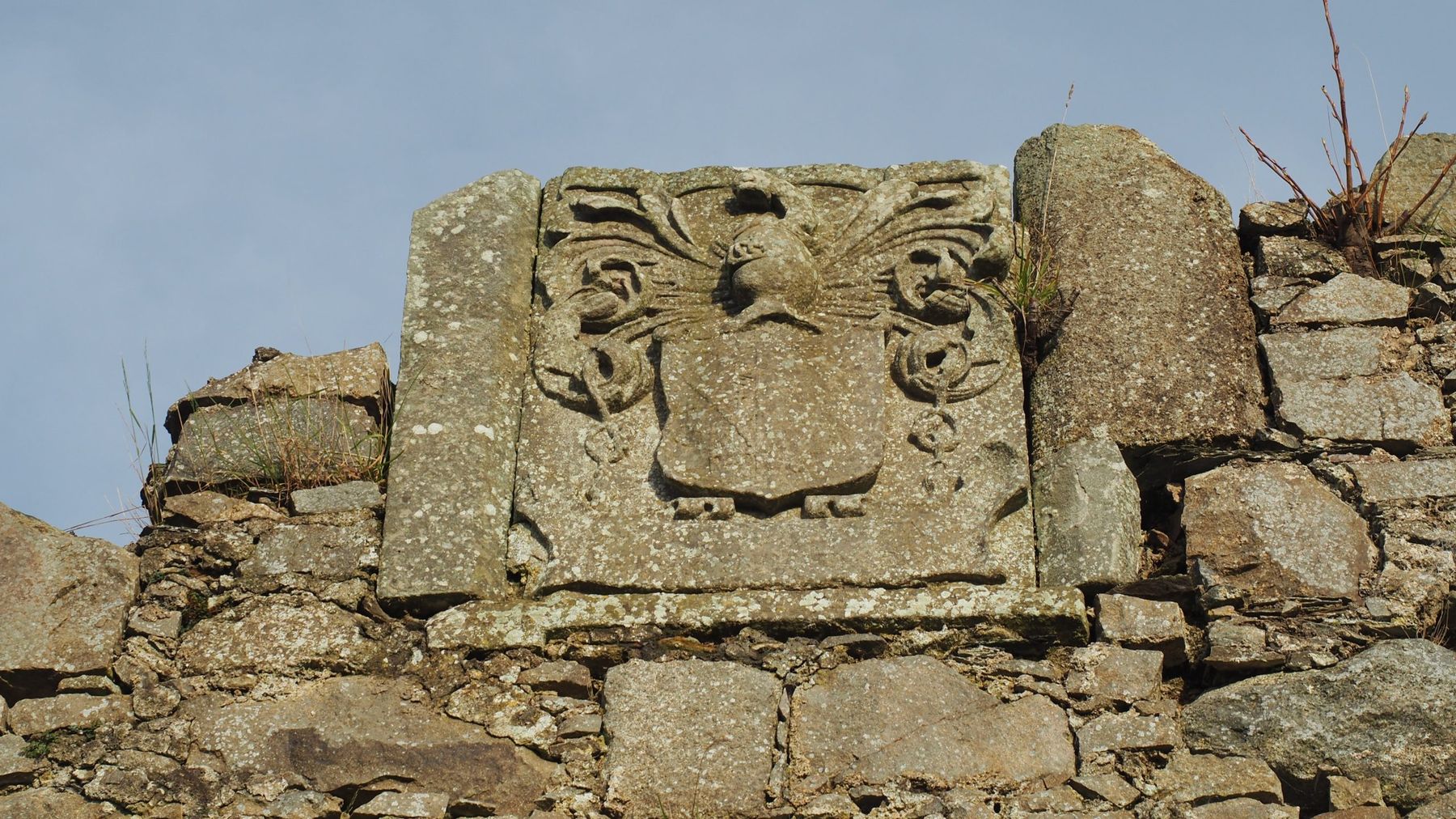
1668–1706
The Forbes years
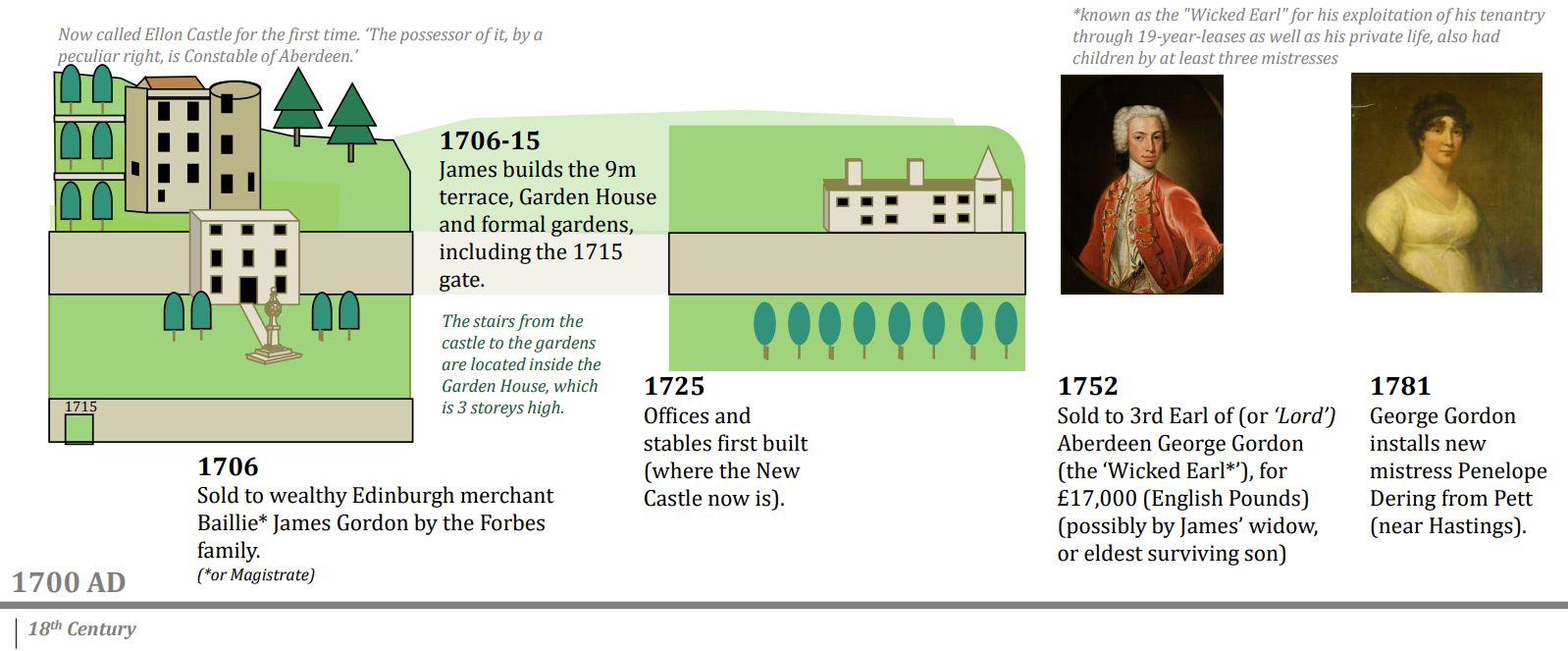
Sir John Forbes of Waterton owns the estate, married to Jane Gordon, sister of the Earl of Aberdeen. Their sons dispose of it, and it is unlikely any of the family lived here.
1715
The walled garden is made
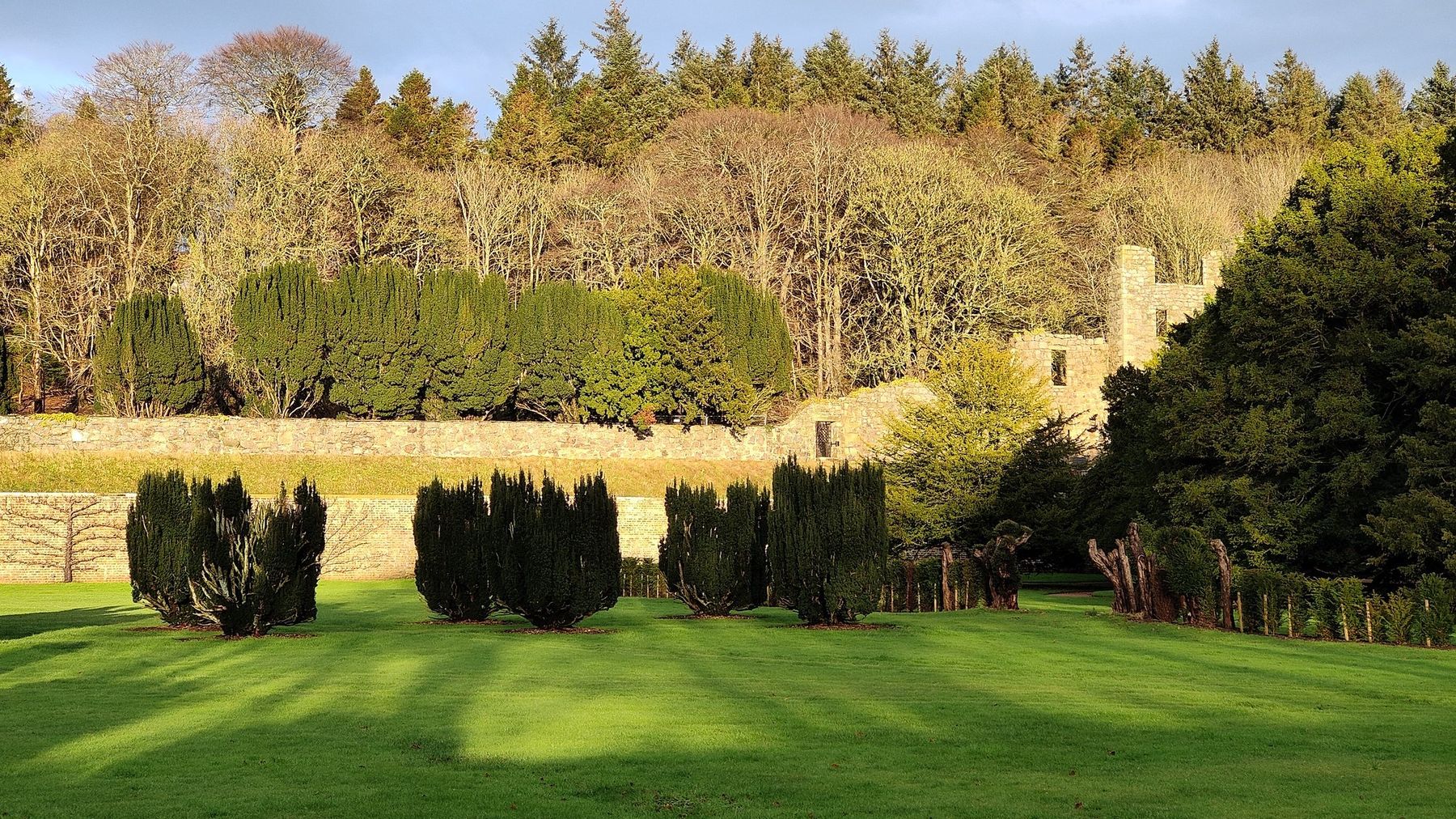
Baillie James Gordon, a wealthy Edinburgh merchant, creates the walled garden and cuts a nine-metre terrace out of the hill. It is the single most important act in the garden's history: the shape you walk around today is his.
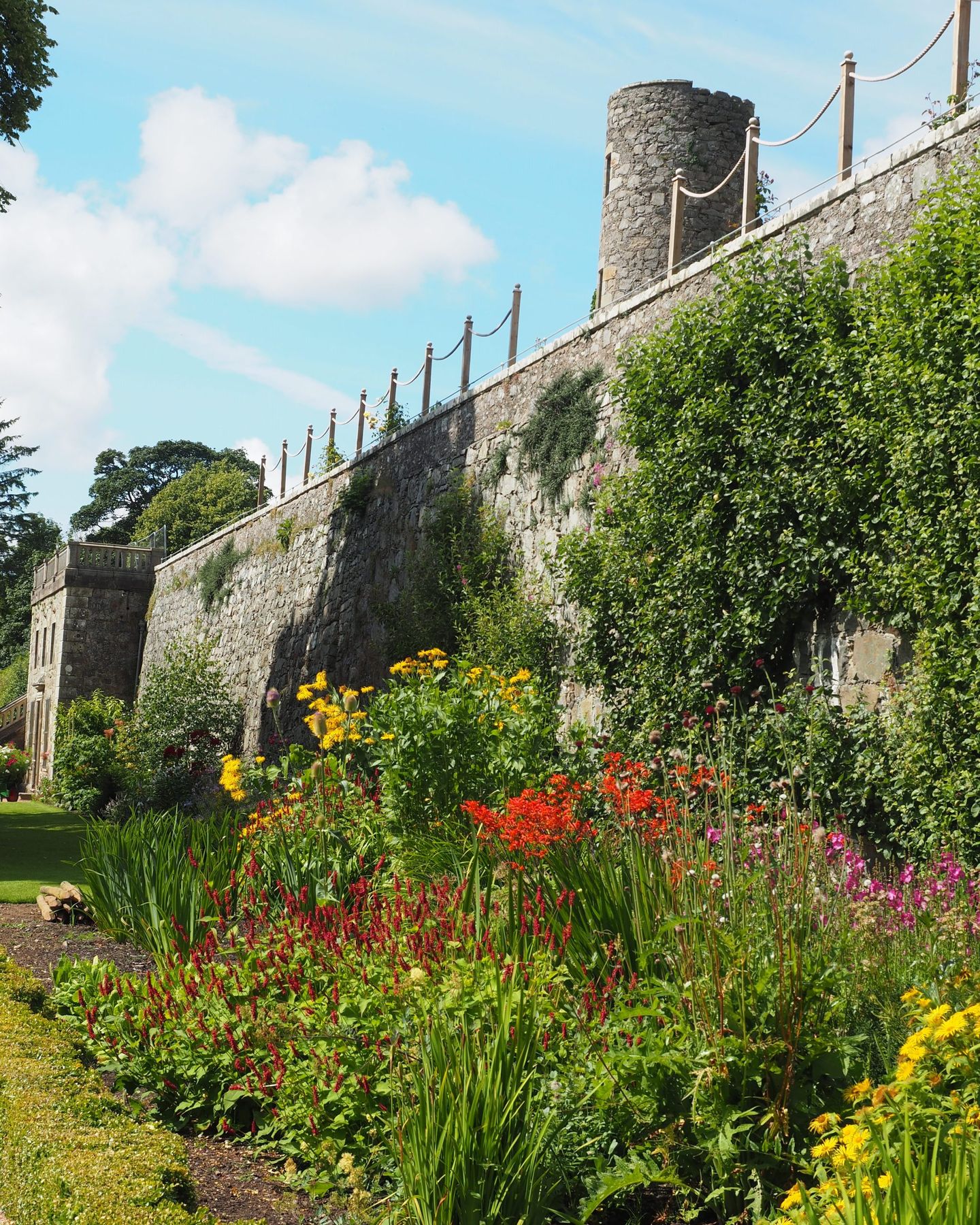
The terrace, carved out of the hillside in 1715. 1717
Murder in Edinburgh
Two of Baillie James Gordon's sons are murdered in Edinburgh by their tutor, Robert Irvine, in revenge for a maid being sent away after an affair. His widow Elizabeth is said to have received 200 guineas to buy a gown, in recompense for giving up her life rent.
1752–1801
The 3rd Earl and Penelope Dering
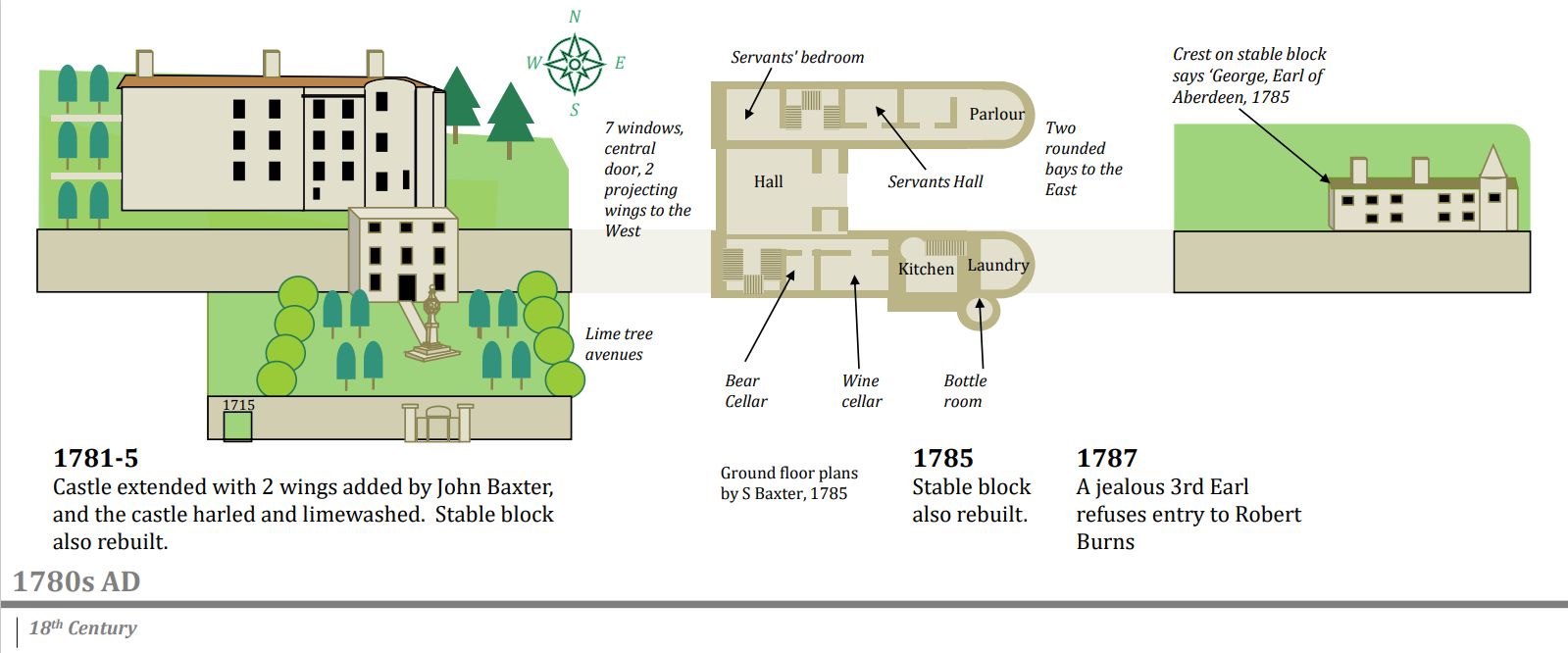
The estate passes to George Gordon, 3rd Earl of Aberdeen, who installs his mistress Penelope Dering from Hastings in the castle. They have two children, Alexander, born 1783, and a daughter also called Penelope. When the Earl dies in 1801 the castle is left to his legitimate son William — with Ellon to pass to Alexander should William die childless.
1752–1801
Penelope Dering
A mistress installed in the castle, and two children written into a will.
George Gordon, 3rd Earl of Aberdeen, brought Penelope Dering from Hastings and installed her at Ellon. They had a son, Alexander, born in 1783, and a daughter, also Penelope.
The Earl arranged that Ellon should pass to Alexander if his legitimate heir William died without children. William duly died childless in 1845, and Alexander inherited — by which time the castle had been left to rot for forty years.
1787
Burns is turned away
Robert Burns passes through Ellon on his northern tour and, by local account, is refused entry to the castle. The Earl was protective of Penelope.
1787
Robert Burns
The most famous man in Scotland gets no further than the gate.
Burns came through Ellon in 1787 on his tour of the north. He was, by the account handed down locally, refused entry to the castle — the Earl being unwilling to have visitors while Penelope was in residence.
It is a small story, and it is not flattering to anybody involved, which is probably why it survived.
1690s–1740s
Jacobite country
The North East is a hotbed of Jacobitism. Supporters of the deposed James VII are paid in 'gun money' struck from melted cannon, redeemable only if he regained the throne. A coin dated 1690 was found in the garden — thrown away, one assumes, by a soldier who had worked out what it was worth.
1690
The Jacobite Coin
Money that was only worth anything if the king came back.
James VII, deposed for refusing to renounce his Catholic faith, could not pay his troops. They were given tokens struck from melted-down cannon — gun money — on the promise that it could be exchanged for real coin once he had the throne again.
A gun money coin dated 1690 turned up in the garden. Somebody, at some point, worked out what it was worth and dropped it.
1808–1845
Polite decay
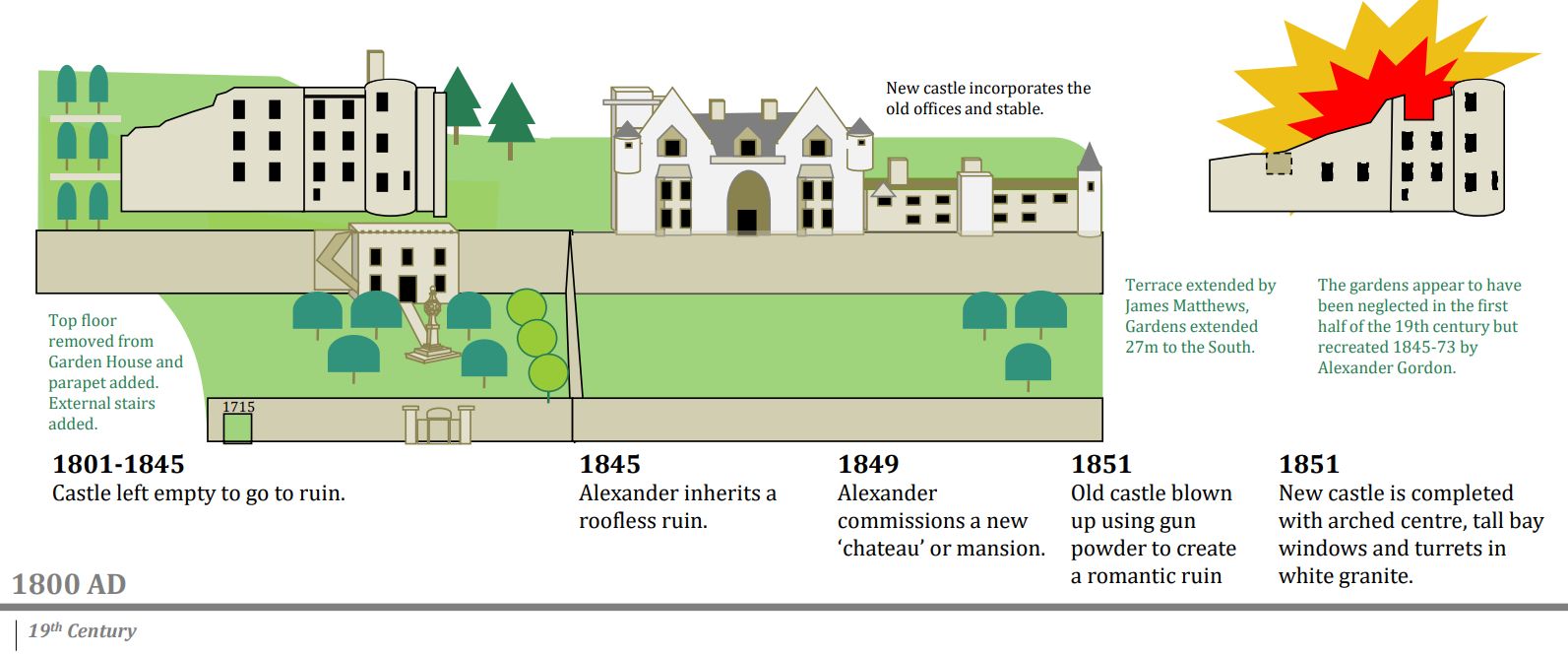
William Gordon, a local MP who does not live locally, advertises the castle's materials in the Aberdeen Journal on 25 May 1808, intending to take it down. Alexander Gordon fights a legal battle to stop him. William lets the place decline for forty years and dies childless in 1845; Alexander inherits at last, and finds it uninhabitable.
1849–1851
A new castle
James Matthews, of Mackenzies & Matthews of Elgin, designs a new mansion. Whether the stone of the old castle went into it, and whether the old castle came down before or after, we still cannot say with certainty.
1873–1913
The Gordons run out of money
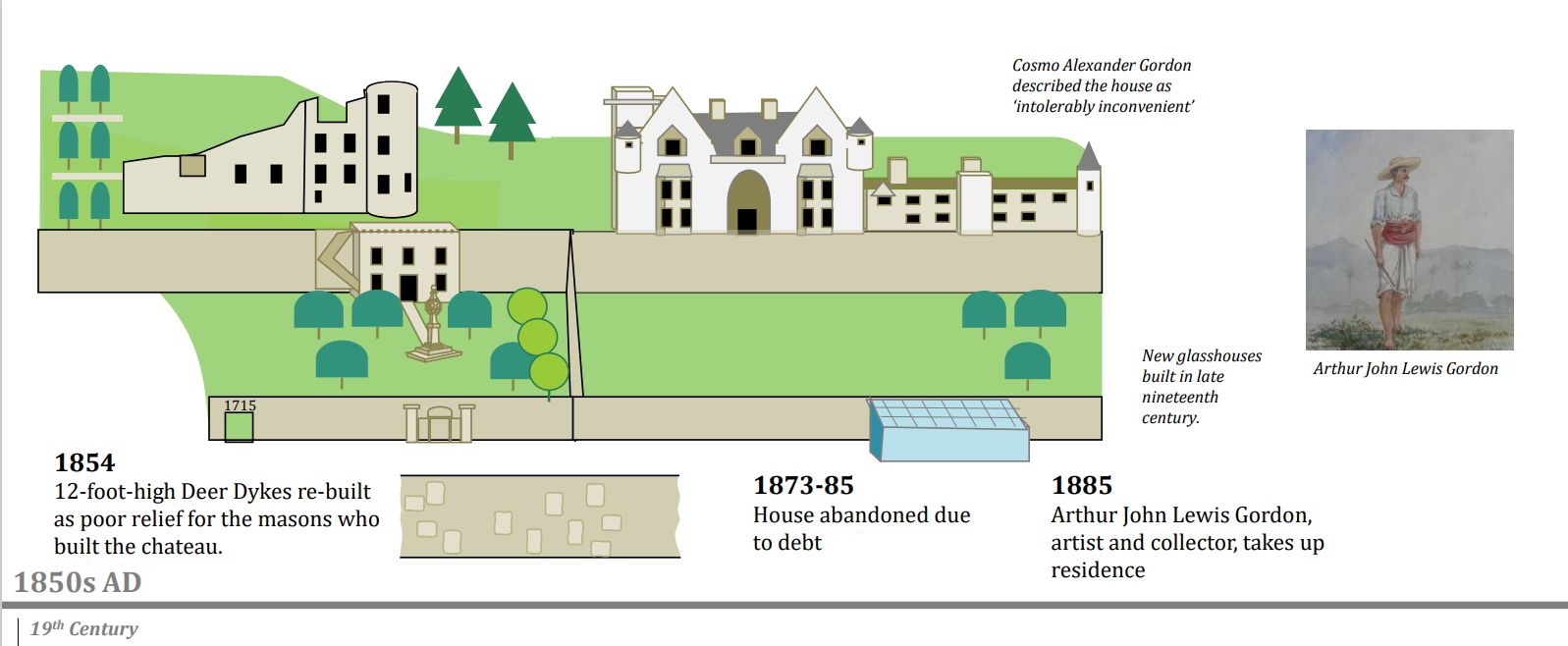
Alexander Gordon dies in 1873 and his son George John Robert inherits, then Arthur John Lewis Gordon, whose son Cosmo Alexander was born at Ellon in 1886. The estate is heavily mortgaged; by 1913 it is being run by trustees. Arthur's aunt, Eleanor Vere Gordon Boyle, artist and illustrator, described this garden in the 1880s in her book Seven Gardens and a Palace.
1919–1929
Sold, then demolished
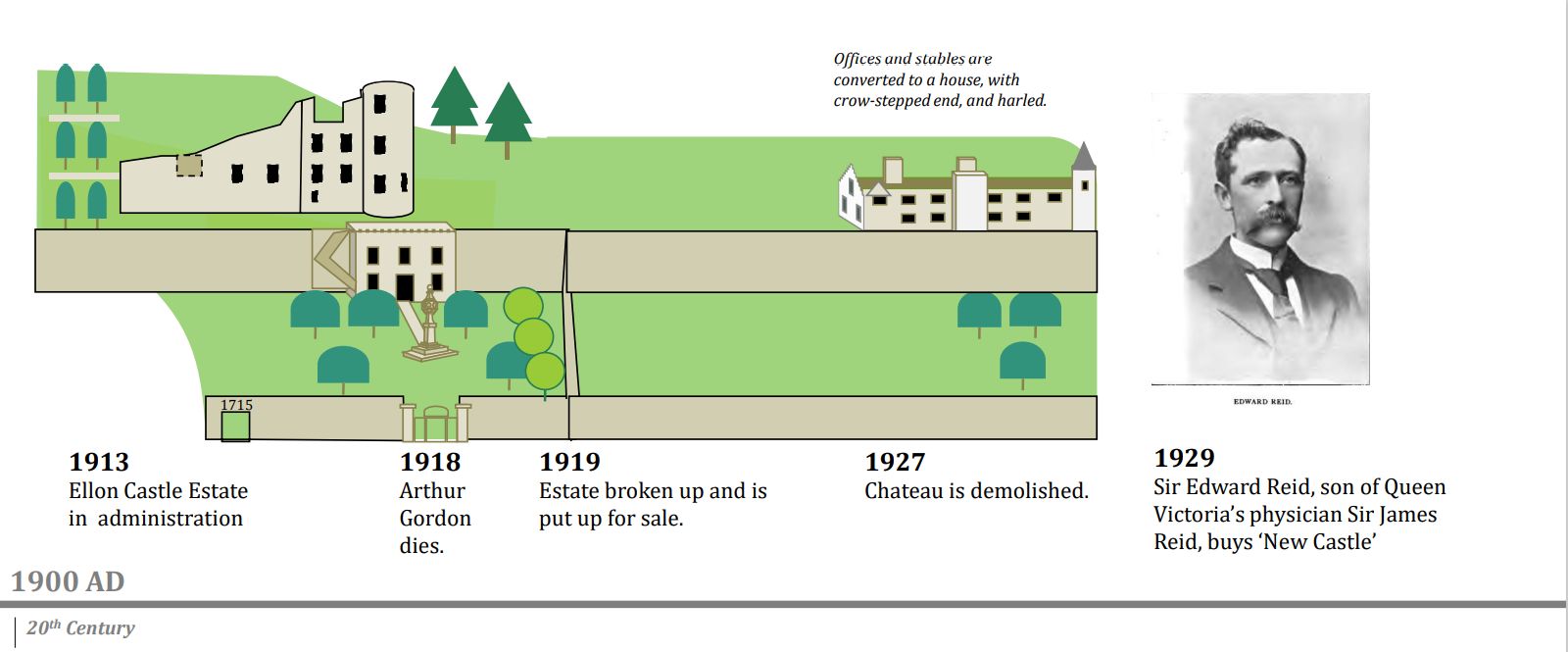
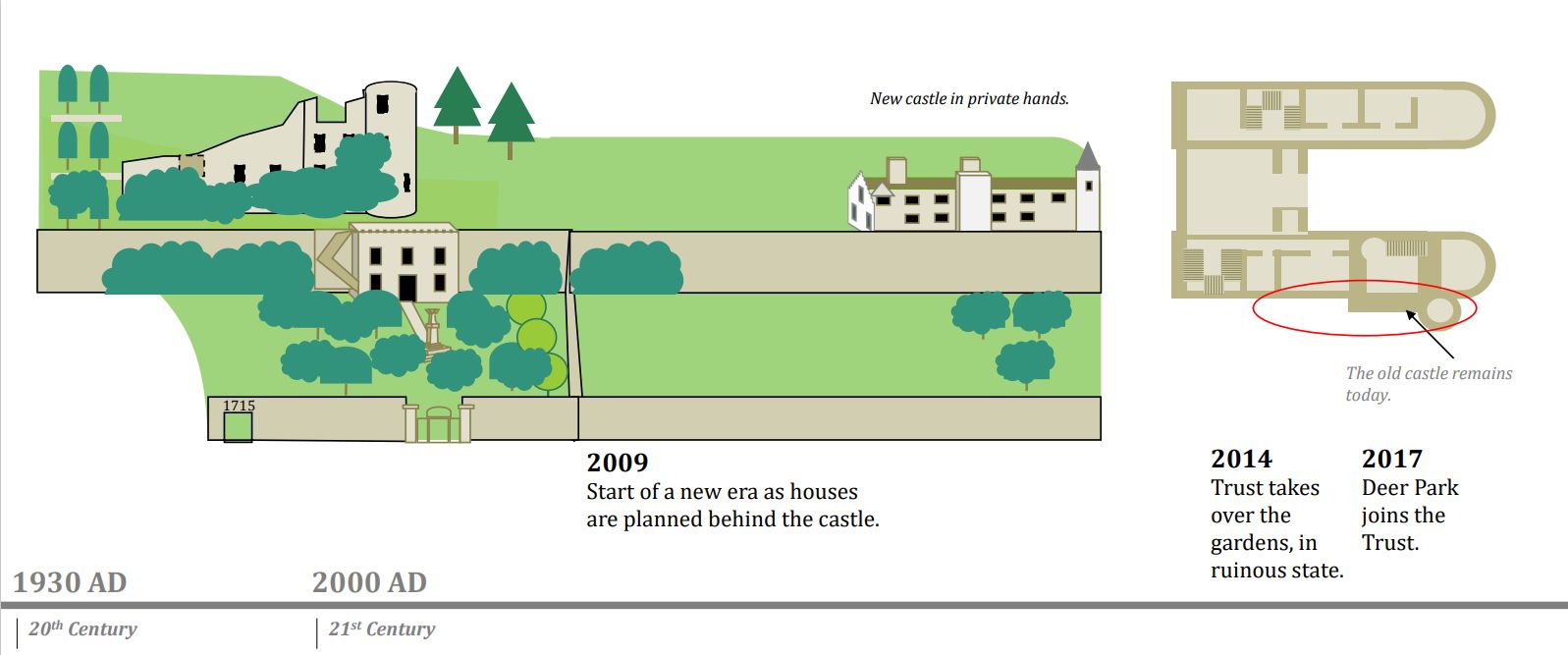
Sir Frederick Becker, a pulp and paper mill owner, buys the estate and sells off the farms, remodelling the old offices as a shooting lodge. In 1927 he has the 1851 mansion pulled down. In October 1929 he sells what remains to Sir Edward Reid, whose father was physician to Queen Victoria.
2009–2012
Houses proposed
Scotia Homes and Barratt Homes apply to develop Castle Meadows and Castlewell. Permission is granted in 2012, with the income from eleven of the 247 proposed houses to go to a community trust to look after the gardens.
2014
The Trust is formed
Ellon Castle Gardens Trust is set up to take on the garden — nine acres of walls, ruins, yews and thirty years of neglected vegetation.
2017
The Deer Park
Aberdeenshire Council sells the Deer Park to the Trust for a nominal £1, bringing the open ground below the garden wall back into the same hands.
Still unresolved
Six things we would still like to know
Who was Isabel Moffat, who sold the Hill of Ardgith in 1413 — and did anything stand on the site before the fortalice?
When were the first yews planted, and was there a connection with the Monastery of Deer?
Where does the secret passage to the Ythan run, if it exists at all?
Was the stone of the old castle used to build the 1851 chateau?
Who sold the castle after Baillie James Gordon's death?
Was the old castle blown up before the new one was built, or afterwards?
Tradition
The Secret Passage
Tunnel, escape route or smuggler's shortcut?
A passage is said to run from the old castle down to the River Ythan. One version has it as an escape route for fleeing Jacobites. The likelier version is smuggling: brandy brought up the river by barge and carried underground into the castle.
Nobody has found it. We keep looking.
Beneath the yews
The Ancient Yews
Trees older than anyone can quite prove.
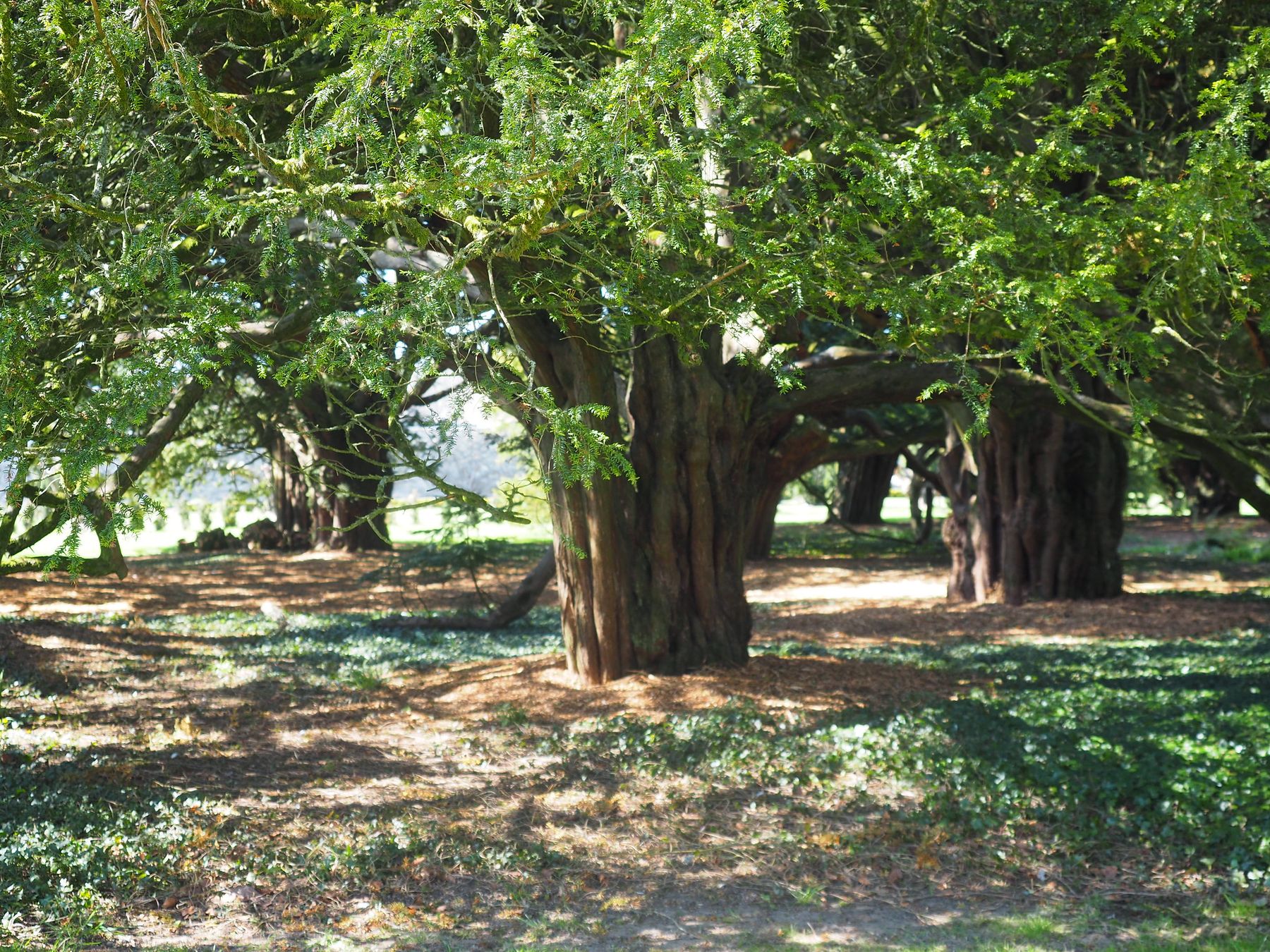
Nineteen English yews stand in the centre of the walled garden. They are reckoned to be at least 500 years old, and some estimates put the oldest at around 800 — which would place them here before the castle.
There is a possible connection to St Mary's, the parish church, once a training centre for monks of the ancient Monastery of Deer. Yews and monasteries go together. Proving it is another matter.